
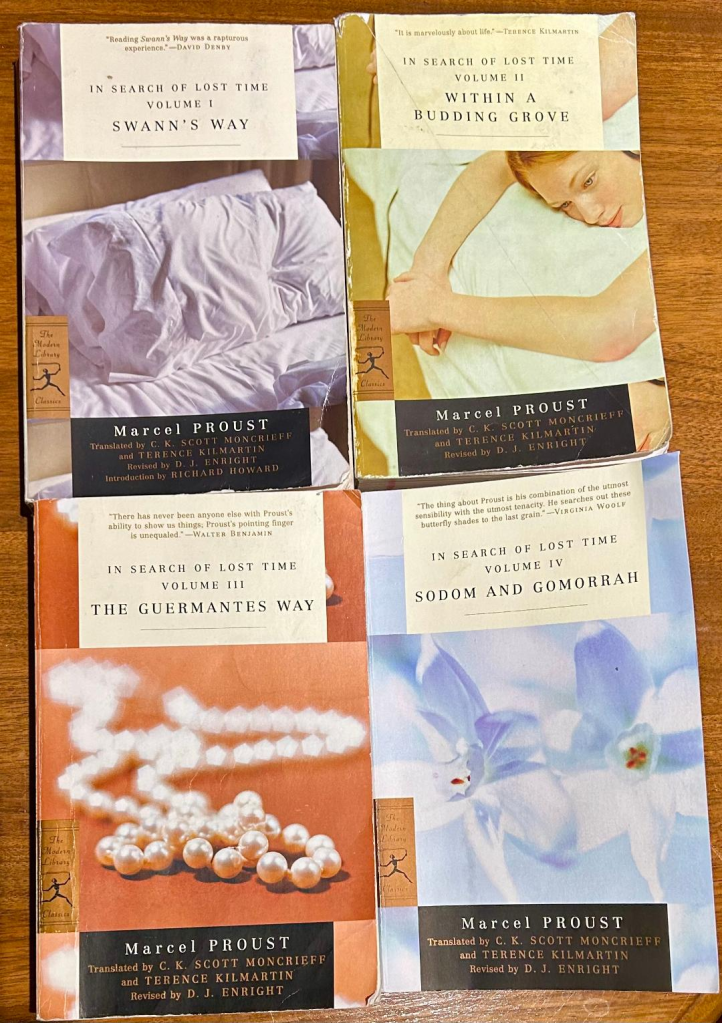
Covers of the first four volumes of The Modern Library Classics edition of Proust’s
IN SEARCH OF LOST TIME
These four book covers are evidence either that I like to read, or of my determination to conquer Mr. Proust’s prose mountain. Maybe both. My enjoyment of the printed word began back on the farm and that was a long time ago. I remember visits from the Rural Bookmobile, subscriptions to Boy’s Life and comic books devoted to Roy Rogers, Tarzan and The Phantom. Before long there was the monthly arrival of a biography of a famous person such as Eli Whitney, the Wright Brothers, George Washington Carver or Robert Fulton. My literary tastes have always been eclectic.
Jumping forward any number of decades, I realized that for all my time with a book in my hands, I had not ‘read the classics’. The COVID shutdown provided some idle moments, and I decided to remedy my position. I began with the plays of Sophocles, Euripides and Aeschylus, moving on to The Nibelungen, Chanson de Roland and Stendhal’s The Charterhouse of Parma.
These led me to the biggies and I settled in for Homer’s Iliad and Odyssey, followed by Vergil’s Aeneid and now Marcel Proust’s magnum opus, In Search of Lost Time. I hasten to add that all this heavy-duty reading was leavened by novels from John Grisham, Donna Leon, Daniel Silva, Michael Connelly, John le Carre, Ian Rankin, Henning Mankel, Simenon, David Baldacci, Jo Nesbo and Camilleri. And has been accomplished over a period of several years.
Having now read the first four volumes of In Search of Lost Time, I am mystified by people’s fear of Proust, an author – I am told – more talked about than read. I have found his book(s) to be very enjoyable, filled with insight into what makes us human, more than a little kinky and most surprisingly, very funny. That guy had a sly sense of humour and threw zingers around of which Stephen Colbert would be proud. When I began Swann’s Way, I worried that it would be a bit of a slog but not at all. He can write a long sentence when he puts his mind to it, but I never get lost and am always rewarded for having paid attention. I was hooked by the opening sentence: “For a long time I would go to bed early.” Yes, and then what? A goodnight kiss from his mother and Marcel lays his “cheeks gently against the comfortable cheeks of my pillows, as plump and fresh as the cheeks of childhood” and quickly enters the world of dreams. “Sometimes, too, as Eve was created from a rib of Adam, a woman would be born during my sleep from some misplacing of my thigh. Conceived from the pleasure I was on the point of enjoying, she it was, I imagined, who offered me that pleasure. My body, conscious that its own warmth was permeating hers, would strive to become one with her and I would awake.” What is this…intimations of incest, a full-blown wet dream and we are only on page three!
It has not escaped me that ‘the classics’ to which I allude were not written in English. I am lucky that I have quite by chance chosen translations that – in my view – are very good. The edition of Homer’s works that I read were translated by Robert Fagles and are idiomatic while retaining what I imagine is the poetry and nobility of the original work. Robert Fitzgerald’s version of the Aeneid is likewise quite colloquial and never did I feel borne down upon by any linguistic awkwardness of a ‘ye olde’ nature. For the Proust, I am reading Enright’s re-revision of Kilmartin’s revision of Scott Moncrieff’s translation from the French. The informal dialogue I find to be particularly adroit and persuasive while the descriptive and observational passages – of which there are many – have a painterly aspect.
As the story progresses, I find myself thinking of Dynasty, and Downton Abbey or one of those everlasting soap operas. The novel covers several decades and slowly recounts the demise of the old aristocracy in Paris between the 1880s and just after the First World War. Proust focuses on the personal lives of a limited number of people who live in the hermetically sealed world of the one-percenters, a world of obliviousness, unearned wealth, fantasy, racism, snobbism, amorality, condescension, perversion and total self-absorption. The every-day world of ‘the common man’ has not intruded into the narrative so far and I don’t think it will. The closest we get are interactions with one- or two-family retainers, a concierge, a comely milkmaid observed from the train, and an attractive lift boy. This blinkered existence reminds me of one of my favourite moments from Downton Abbey when Dame Maggie, aka the Dowager Duchess of Grantham, innocently asks: “What’s a weekend?” None of Proust’s characters would know either! Downton Abbey sprang – we are told – completely from the imagination of Julian Fellowes but the more I read of In Search of Lost Time, the more I wonder if he didn’t keep those seven volumes close to hand. And why not…? An acquaintance of mine once pronounced that originality was nothing more than clever stealing.
My venture into Proust’s world has been aided by a number of books, touching on various aspects of his life and his art: A Reading of Proust by Wallace Fowlie, How Proust Can Change Your Life by Alain de Botton, The Proust Project edited by Andre Aciman, Proust by Roger Shattuck and A Proust Souvenir by William Howard Adams, with photographs by Paul Nadar. I encourage anyone who contemplates reading the novel to take advantage of works such as these, since Proust is so all-encompassing, so many-layered, that coming to him un-baptized can be a bit daunting.
As noted earlier, I have enjoyed and am enjoying the novel immensely. It’s a whacking good tale with many engaging story lines. It will take me a while to think through the underlying themes of memory, the nature of art, love and time as it affects our concept of reality. Luckily, I have the time! Most importantly, I appreciate that Proust is an observer and completely non-judgmental. What he sees, he records and does not editorialize.
I have three volumes to go. I expect that The Captive and The Fugitive will be the most intense and demanding as they are detailed accounts of his obsession with the unknowable Albertine. And then the finale, Time Regained, which I suspect is a farewell to a world that no longer exists, except as we search for a time lost.


Leave a comment